Rita’s initial investment is more accessible than most food service franchises. Understanding what that investment actually covers helps explain why.
When entrepreneurs begin researching food franchise opportunities, startup costs are usually one of the first filters they apply. The numbers can vary enormously depending on the concept, the format, and the operational complexity involved. Rita’s Italian Ice & Frozen Custard sits at a different point on that spectrum than a full-service restaurant or a traditional QSR brand, a difference that matters as much as the numbers themselves.
According to Rita’s 2026 Franchise Disclosure Document (FDD), the total estimated initial investment for a standard Rita’s shop without a drive-thru ranges from $295,233 to $712,542. A standard shop with a drive-thru runs between $436,858 and $915,536. Those ranges reflect real buildout variables, such as lease markets, site conditions, and local permitting. But the underlying cost structure centers a concept that was designed from the start to operate without the overhead that drives costs up in traditional restaurant models.
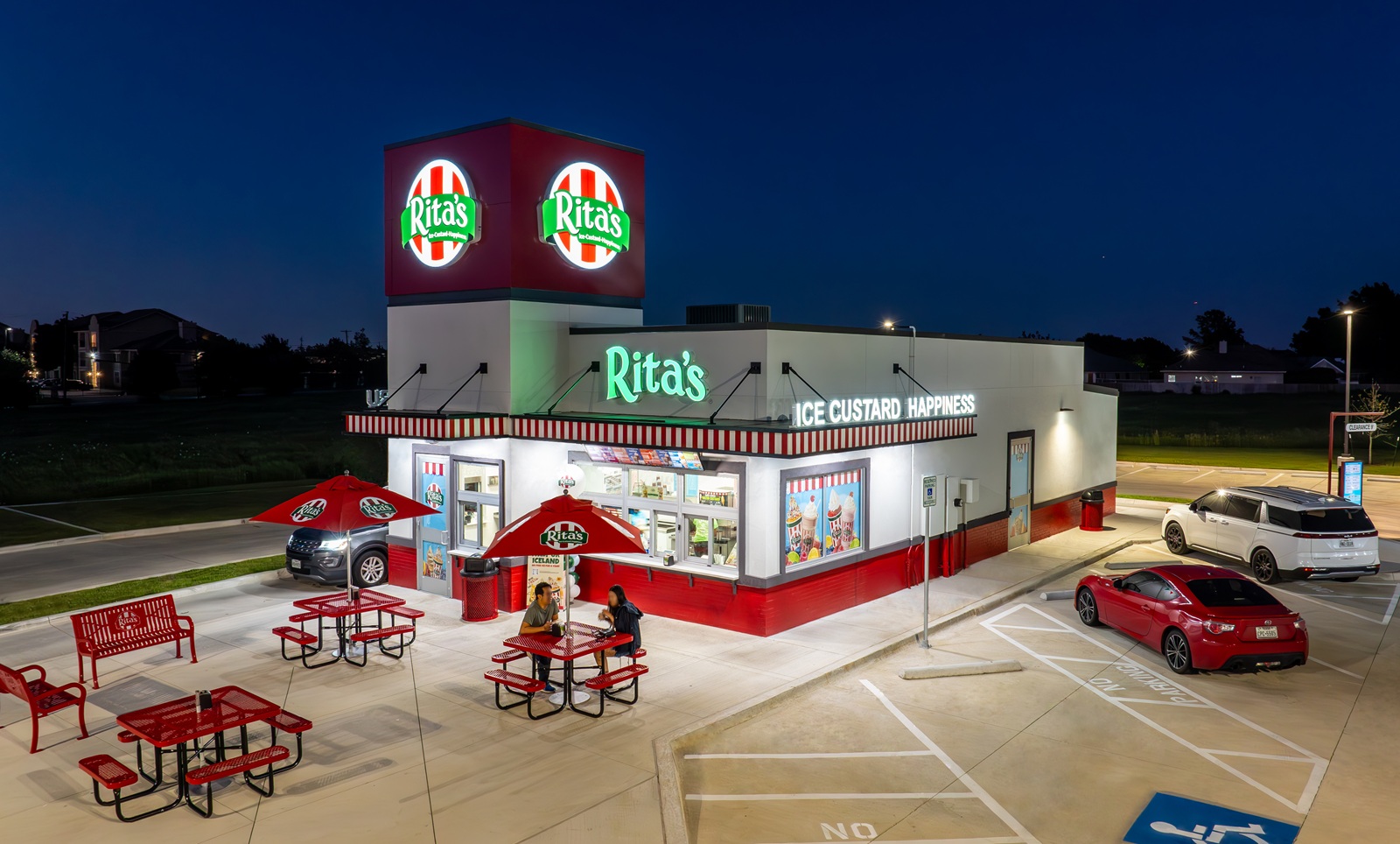
There are no grills, stoves, fryers or ovens. Nor are there ventilation systems or grease traps. The absence of a conventional kitchen provides a structural advantage that ripples through nearly every cost category an owner has to manage.
A Simple Product With a Significant Cost Advantage
The Rita’s menu is built around two core products: Italian Ice and Frozen Custard. Everything served, including the Gelati, Blendinis, and other menu combinations, comes from some variation of those two items. Instead of a limitation, this focus provides the operational foundation that keeps the business manageable and the cost of goods sold (“COGS”) consistently low.
The average combined cost of food, paper, and fuel surcharge across the system was 17.3% of gross sales in 2025 (“COGS” Cost of Goods Sold). For top-tier shops, that figure was 16.0%. Those numbers reflect what Rita’s has understood since Bob Tumolo first started selling Italian Ice from his front porch in Philadelphia in 1984: when your ingredients are water, sugar, dairy, and real fruit, you are not fighting the same margin pressure that full-menu concepts face every day.
There is also very little spoilage risk in this model. Italian Ice and Frozen Custard are made fresh daily, but the ingredient base doesn’t carry the same vulnerability to waste that protein-heavy or produce-intensive menus do. For an owner managing cash flow, that is a meaningful structural advantage.
What the Investment Actually Includes
The startup investment for a Rita’s shop covers more than construction and equipment. It covers entry into a system that has been refined across hundreds of locations over four decades.
Rita’s has been in business since 1984. The brand now operates nearly 600 locations across more than 30 states, with even more room to grow. That scale means the vendor relationships, equipment specifications, and supply chain infrastructure are already established. An incoming franchisee won’t build those relationships from scratch or negotiate alone with unfamiliar suppliers. The buying power of the system is behind every purchase.
The $35,000 initial franchise fee, included in the investment totals cited above, is what grants access to that system. It covers the rights to operate under the Rita’s brand, use of proprietary recipes and systems, and the operational framework that comes with joining an established franchise network.
Rita’s also requires a minimum new shop marketing expenditure of $12,000 in the period before opening, which is included in the Item 7 estimates. That investment funds the local launch activities designed to drive awareness and traffic in the critical early weeks of operation. Rita’s works with franchisee side-by-side on the best ways to allocate this funding.
Training and Operational Support
New Rita’s franchisees go through Cool University, Rita’s dedicated training program that covers operations, customer service, and local marketing. The program is designed to prepare owners to run their shops with confidence before their doors open, with hands-on training built into the curriculum alongside the classroom components. Ongoing coaching and business development support continues after opening.
The training model reflects something important about Rita’s business more broadly: the menu is focused enough that preparation is genuinely learnable. Employees can typically be trained in one or two shifts. Shops generally operate with one to five team members per shift, including a shift lead. That lean staffing model is part of what makes the labor cost structure manageable. It’s also one of the reasons Rita’s has a track record of attracting and retaining younger employees who are available during the brand’s busiest hours.
Format Flexibility and the Path to Growth
Rita’s offers multiple shop formats, giving prospective owners meaningful flexibility in how they enter the system and how they grow over time.
The standard shop is the core format: walk-up or walk-in service, with options for seasonal or year-round operations depending on the market. For owners in warmer climates or high-traffic areas, year-round operations are well-supported. For owners in seasonal markets, the traditional March-through-October model has proven durable for decades, with the annual reopening carrying its own community momentum. Finally, adding a drive-thru can allow owners to extend their season in all markets, often to year-round even in the northern markets.
For owners interested in a drive-thru configuration, the 2026 FDD data is worth considering directly. According to Item 19, drive-thru shops in the 2025 sample averaged $508,897 in gross sales compared to $366,957 for non-drive-thru shops (+39%). That gap does come with higher buildout costs, but the investment range for a drive-thru shop reflects that tradeoff.
Beyond the fixed shop formats, the Rita’s model is designed to extend beyond four walls. Satellite locations can be added under a franchisee’s existing agreement, along with creating additional revenue streams through catering and community events. That scalability is part of why multi-unit ownership is common within the Rita’s system. Many franchisees expand to additional locations once their first shop is established, a path laid out clearly in Rita’s ownership process.
What the Numbers Have Looked Like Over Time
For prospective franchisees evaluating long-term potential, the historical sales trajectory in the FDD offers useful context. According to Item 19 of the 2026 FDD, average gross sales for top-tier shops grew from $317,000 in 2018 to $558,103 in 2025, an increase of approximately 76% over that period. Middle-tier shops saw average gross sales rise from $206,000 to $345,566 over the same span, and bottom-tier shops moved from $121,000 to $220,095.
These figures are reported from franchisee PoS (Point of Sale) data and represent historical performance rather than a guarantee of future results. Individual outcomes will vary based on location, market conditions, operational execution, and many other factors detailed in the FDD. But the directional consistency across all three tiers over an eight-year period, including through the disruptions of 2020, reflects a business model with underlying resilience.
Taking the Next Step
The best way to evaluate whether Rita’s is the right fit is to go through the discovery process directly. That includes reviewing the full Franchise Disclosure Document (“FDD”), which contains the complete Item 19 financial performance data, Item 7 investment tables, and detailed notes on what the figures do and do not include. Prospective franchisees are encouraged to work with an attorney and accountant when reviewing the FDD.
To learn more about available territories and begin the conversation, contact the franchise development team.
This information is not intended as an offer to sell, or the solicitation of an offer to buy, a franchise. Financial performance figures referenced above are sourced from Item 19 of the Rita’s Franchise Company, LLC Franchise Disclosure Document, dated January 30, 2026. Some outlets have sold this amount. Your individual results may differ. There is no assurance that you’ll sell as much.